
From Siloed Systems to Shared Outcomes: Interoperability’s Role in Person-Centered Service Networks
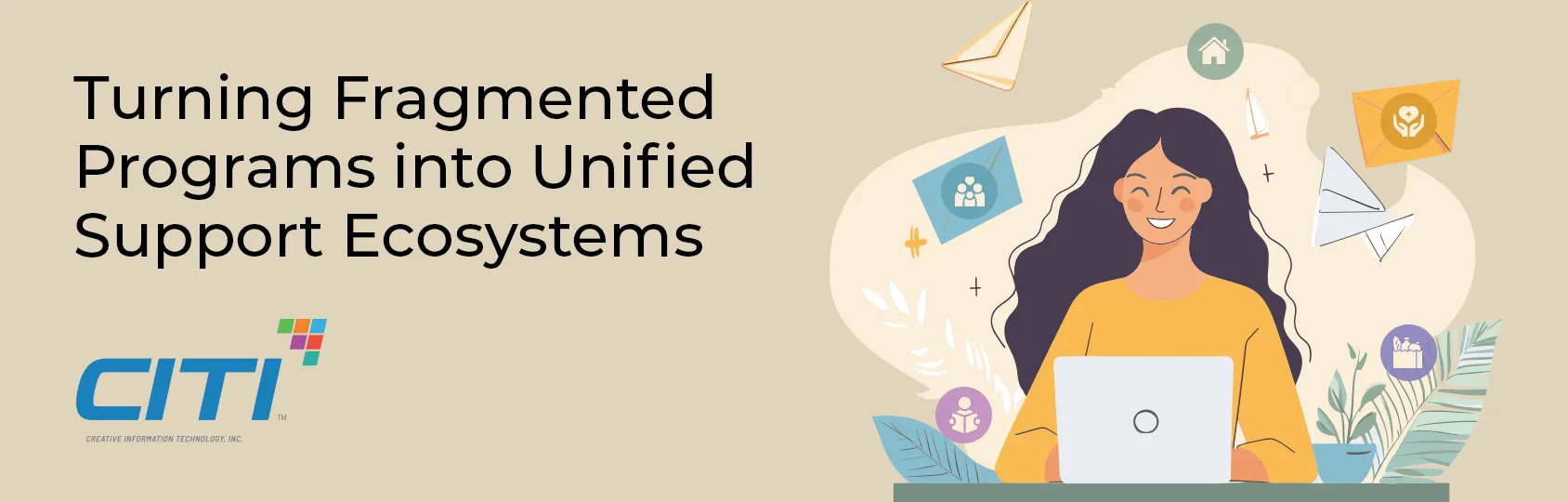
To understand why interoperability matters, it helps to begin not with technology, but with people. Imagine a typical morning for a parent navigating multiple public benefit programs. Picture the screens, the paperwork, the waiting, and the quiet uncertainty that comes with each step. This is where many human services journeys begin.
A Family Navigating Fragmented Systems
On a Tuesday morning before work, Jennifer sits at her kitchen table with her laptop open and her phone balanced against a coffee mug. On one screen, she is filling out an application for child care assistance. On the other, she is searching for a number to check the status of her SNAP benefits. Later that afternoon, she will visit a clinic to complete paperwork for Medicaid renewal. Each form asks the same questions. Each office requires the same documents. Each system holds a piece of her story, but none of them hold the whole picture.
For Jennifer, accessing human services feels less like receiving support and more like navigating a maze. She repeats her circumstances to different caseworkers. She uploads the same pay stubs multiple times. She waits for approvals that seem disconnected from one another. Every delay affects her ability to work, care for her children, and plan for the future. Her life is integrated. The systems meant to support her are not.
The Cost of Fragmentation
This fragmentation carries a hidden cost. When programs operate in isolation, duplication becomes routine. Caseworkers spend hours reconciling information across platforms. Supervisors struggle to access unified data for planning and reporting. Clients experience confusion and frustration and trust erodes. What should be a coordinated network of support becomes a collection of disconnected transactions.
For staff, the burden is equally impactful. Switching between systems, manually verifying records, and piecing together incomplete profiles consume time that could be spent helping families stabilize and thrive. Fragmentation does not simply slow processes. It reshapes how work is experienced, shifting focus away from people and toward paperwork.
When Systems Begin to Talk
Now imagine a different version of Jennifer’s story.
In this version, her initial application connects automatically to related programs. Information entered once flows securely across systems. Her caseworker sees her full service history in a single interface. When her income changes, updates are reflected everywhere they need to be. Referrals are generated automatically. Status notifications are clear and consistent.
Instead of juggling phone calls and portals, Jennifer receives coordinated guidance. Approvals arrive faster, requirements are easier to understand, and stress is replaced with confidence. This is not a distant vision. It is the practical result of interoperability done well.
Interoperability as Public Infrastructure
Interoperability is often discussed as a technical feature. In reality, it is infrastructure. Like roads, utilities, or communication networks, it operates in the background, shaping what is possible without demanding attention. Strong interoperability is built on shared data standards, consistent business rules, secure access controls, and coordinated workflows.
When this foundation is in place, programs can function as parts of a unified system rather than isolated entities. Consistency replaces fragmentation. Coordination becomes routine rather than exceptional.
From Program Ownership to Shared Responsibility
Interoperability infrastructure enables something deeper than efficiency. It creates shared responsibility.
Consider the perspective of a caseworker named James. With access to integrated data, James no longer sees only the program he administers. He sees patterns across the public assistance ecosystem. He notices when housing instability coincides with child care gaps. He identifies early signs of risk when benefits lapse across multiple programs. He coordinates with colleagues instead of working in parallel.
Interoperability transforms individual case management into collaborative care. While, accountability shifts from managing programs to supporting people and decision-making becomes proactive rather than reactive.
Restoring Capacity Through Reduced Duplication
Reducing duplication is another critical part of this transformation. When documents are submitted once, verified once, and used across programs, capacity is restored. One upload replaces three. One verification replaces repeated requests. One intake replaces multiple interviews.
Time and money saved can be reinvested in outreach, prevention, and personalized support.
CITI’s Role in Building Connected Service Networks
At CITI, this vision of connected, person-centered service networks informs how platforms are designed and implemented. Through enterprise architecture, shared data models, configurable workflows, and secure integration frameworks, CITI helps agencies move beyond fragmented systems toward coordinated ecosystems.
Interoperability is treated as a long-term commitment to consistency, flexibility, and trust. It is embedded into modernization efforts from the beginning, ensuring that agencies can adapt to policy changes, evolving community needs, and growing demand without rebuilding from scratch.
From Systems That Divide to Networks That Support
When systems are connected, stories like Jennifer’s change.
She spends less time navigating bureaucracy and more time building stability. Her caseworker works with complete information. Programs reinforce rather than contradict one another. Support feels coherent instead of scattered.
From siloed systems to shared outcomes, interoperability reshapes human services into what they were always meant to be: networks that reflect the interconnected nature of real lives. By investing in shared infrastructure and collaborative design, agencies can move from managing programs to strengthening communities.